
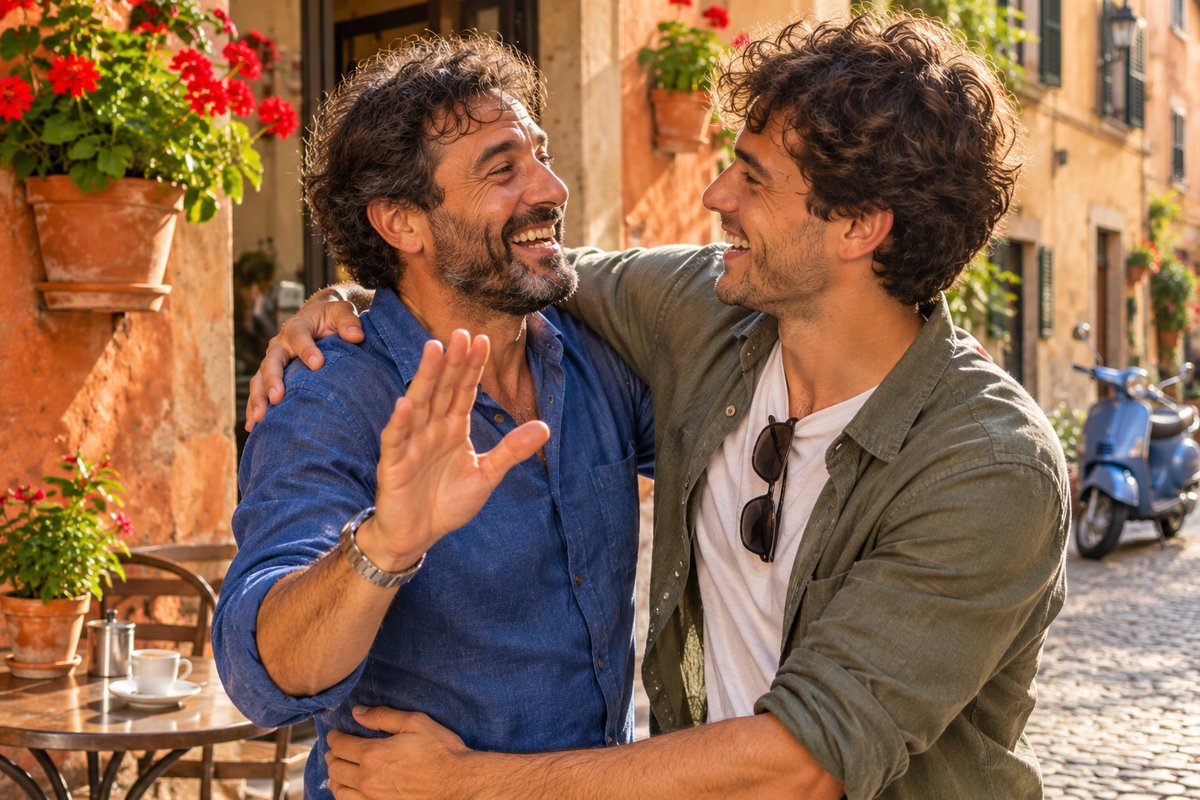
Every Italian course starts with the same question: Come stai? (How are you?). And almost every beginner gives the same answer: Bene, grazie. It is correct, but after a while it sounds like a recording. Real Italians answer in many different ways, depending on the mood, the person and the moment. In this guide you will learn how to ask how are you in Italian, and five natural answers that go beyond bene.
Three ways to ask: tu, Lei and voi
First, choose the right form. Italian changes the question according to who you are talking to:
- Come stai? for one friend, family member or colleague you know well (informal “you”).
- Come sta? for one person you do not know well, or someone older or in a formal setting (formal “you”).
- Come state? for two or more people.
Other common ways to ask, all informal: Come va? (How is it going?), Tutto a posto? (Everything OK?) and Che si dice? (What’s up?).
1. Tutto bene
The most natural answer among friends. It means “all good” and it is a little warmer than a plain bene.
- Ciao Marco, come va? Tutto bene, grazie! E tu? (Hi Marco, how is it going? All good, thanks! And you?)
2. Non c’è male
Literally “there is no bad”. It means “not bad”, and Italians say it all the time, with a small smile. It is a good answer when things are fine but nothing special is happening.
- Come stai? Non c’è male, grazie. (How are you? Not bad, thanks.)
3. Così così
This is the Italian “so-so”. You can say it when you are not feeling great but you do not want to explain why. Often the hand moves from side to side, too.
- Come stai? Così così, sono un po’ stanco. (How are you? So-so, I am a bit tired.)
4. Alla grande!
Use it when you are really happy. It means “great!” or “fantastic!”, and it is informal, so keep it for people you know.
- Come va? Alla grande! Domani vado in vacanza. (How is it going? Great! Tomorrow I am going on holiday.)
5. Sono un po’ stanco / stanca
Italians are happy to say how they really feel, in a relaxed way. Use stanco if you are a man and stanca if you are a woman. You can also try sono occupato / occupata (I am busy) or sono felice (I am happy).
- Come stai? Sono un po’ stanca, ma sto bene. (How are you? I am a bit tired, but I am fine.)
Don’t forget to ask back
In Italian conversation, you almost always ask the question back. The easiest way is to add a short phrase after your answer:
- E tu? (And you?) with a friend.
- E Lei? (And you?) in a formal situation. Write Lei with a capital letter.
- E a te? or E voi? are also possible, for a bit of variety.
Two short dialogues
Read these aloud and notice the different tone.
With a friend:
- Luca: Ciao Anna! Come va? (Hi Anna! How is it going?)
- Anna: Non c’è male, grazie. E tu? (Not bad, thanks. And you?)
- Luca: Alla grande! Domani è venerdì. (Great! Tomorrow is Friday.)
In a formal situation:
- Signor Bianchi: Buongiorno, signora Rossi. Come sta? (Good morning, Mrs Rossi. How are you?)
- Signora Rossi: Bene, grazie. E Lei? (Fine, thank you. And you?)
- Signor Bianchi: Tutto bene, grazie. (All good, thank you.)
Three common mistakes to avoid
- Saying “sono bene”. English speakers translate “I am well” word for word. In Italian we say sto bene (I am well) or simply bene. The verb stare is used for how you feel physically. The verb essere is used with adjectives like stanco or felice.
- Using tu with someone you do not know. With a stranger, an older person or a client, say Come sta? and reply with E Lei?.
- Forgetting to ask back. If you answer and stop, the conversation feels cut short. Add E tu? or E Lei? every time.
Practise it today
Say these situations out loud in Italian, without looking at the answers above:
- A friend asks how you are. You are doing well. Answer and ask back.
- Your neighbour, who is much older than you, asks how you are. Answer and ask back politely.
- You had a long day and you are tired. Tell your colleague.
- Ask two friends how they are.
- You are in a fantastic mood. Say so.
If you want more everyday phrases for your first conversations, read How to Introduce Yourself in Italian: 10 Phrases for Your First Conversation. Then continue with Mi piace or Mi piacciono? A Simple Guide to Liking Things in Italian.
Learn with a teacher by your side
Small talk is easier when you practise it with someone who can correct you as you speak. Book a free assessment call and we will find the right course for you, with no obligation. You can also download my free Italian PDFs, including one with ten expressions you will actually hear.
