
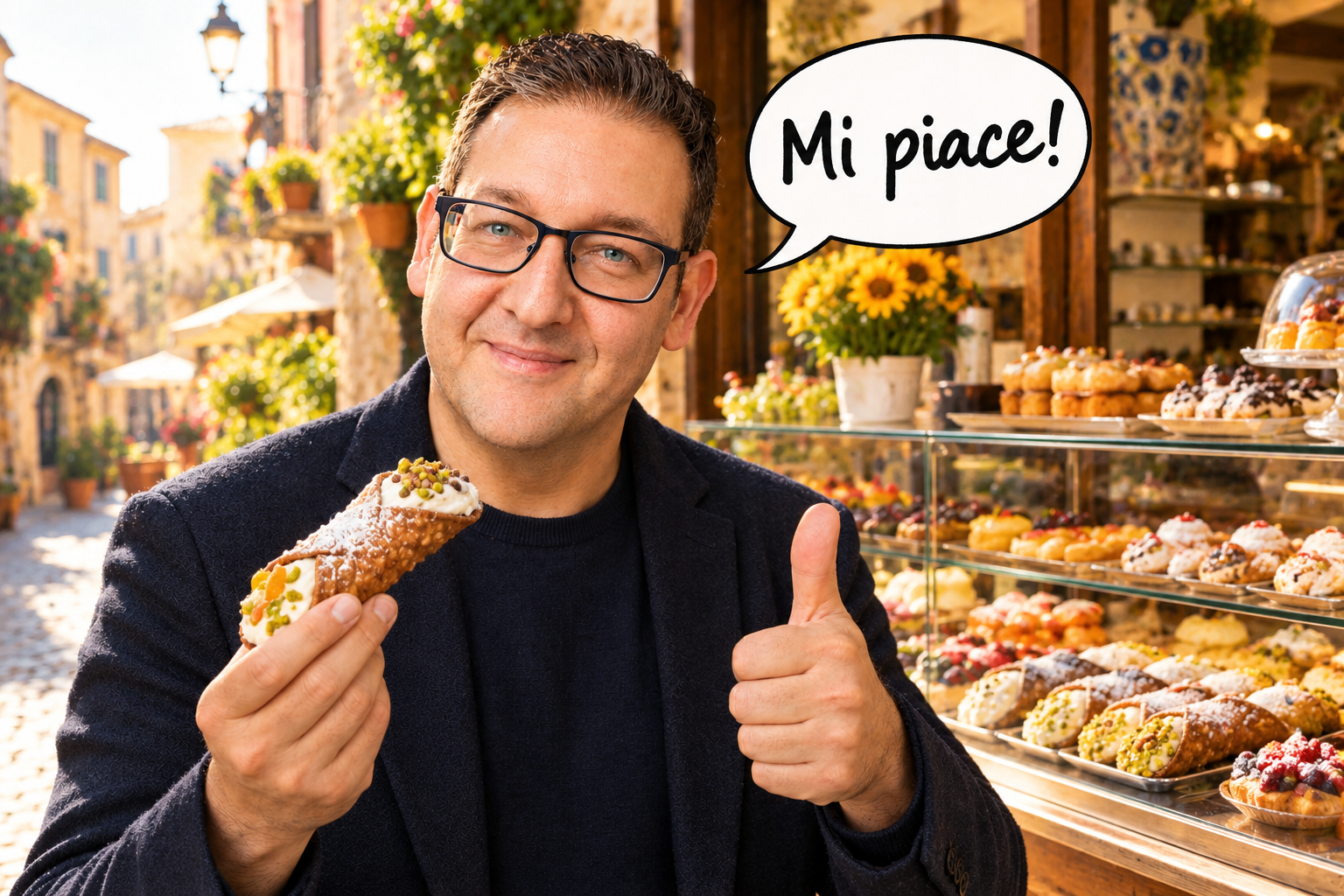
If you are learning Italian, one of the first things you want to say is what you like. Pizza, football, your teacher, a new song. And that is exactly where many beginners get stuck, because in Italian mi piace does not work like “I like” in English. The good news is that the rule is simple once you see it the right way round.
Why “mi piace” is not “I like”
In English, you are the one doing the liking: I like pizza. In Italian, the thing you like is the subject, and it is the thing that “pleases” you. So mi piace la pizza literally means “pizza is pleasing to me”.
This is why Italian says mi piace and not io piaccio. The word mi means “to me”, and piace agrees with what you like, not with you.
Mi piace or mi piacciono?
The verb changes depending on what you like:
- One thing (singular): Mi piace il caffè. (I like coffee.)
- Many things (plural): Mi piacciono i gatti. (I like cats.)
- A verb: Mi piace cucinare. (I like cooking.)
A quick tip: if you are not sure, look at the thing you like. One thing, piace. More than one, piacciono. When you like an action, the verb always stays in the singular: mi piace leggere, mi piace viaggiare.
Changing “mi” to talk about other people
The little word before piace is an indirect object pronoun. It tells us who likes the thing. Here is a quick schema you can save:

MI PIACE: the quick guide
The formula: pronoun + piace / piacciono + the thing you like
| What you like | Use | Example |
|---|---|---|
| One thing | mi piace | Mi piace il caffè. |
| Many things | mi piacciono | Mi piacciono i gatti. |
| An action | mi piace + verb | Mi piace cucinare. |
| Not liking | non mi piace / piacciono | Non mi piace il freddo. |
| Someone by name | a + name + piace | A Marco piace il calcio. |
| Who likes it | Pronoun | Example |
|---|---|---|
| I | mi | Mi piace Roma. |
| You | ti | Ti piace Roma? |
| He | gli | Gli piace Roma. |
| She | le | Le piace Roma. |
| We | ci | Ci piace Roma. |
| You all | vi | Vi piace Roma? |
| They | gli (or loro) | Gli piace Roma. |
Remember: the verb agrees with the thing you like, not with who likes it.
In everyday speech, Italians usually say gli for “to them” too. Loro is more formal and goes after the verb.
Using “a” with a name or a person
When you want to say who likes something by name, add a:
- A Marco piace il calcio. (Marco likes football.)
- A Giulia piacciono i film italiani. (Giulia likes Italian films.)
You can also stress yourself or another person: A me piace il tè, a te piace il caffè. (I like tea, you like coffee.)
How to say you do not like something
Put non before the pronoun: Non mi piace il freddo. (I do not like the cold.) Non gli piacciono le verdure. (He does not like vegetables.)
And to say you like something a lot, use mi piace molto or mi piace tantissimo. For something you love, adoro or amo are also common.
Three common mistakes to avoid
- Saying “io piaccio” for “I like”. It actually means “I am pleasing”, so people will smile. Use mi piace.
- Forgetting the plural. Say mi piacciono gli spaghetti, not mi piace gli spaghetti.
- Mixing up gli and le. Gli is for him, le is for her.
Practise it today
Try writing five sentences about what you like and what your family likes. Mix singular and plural, and use at least three different pronouns. Saying them aloud makes them stick much faster.
Join my free live lesson
I am teaching a free live lesson on “mi piace” and indirect pronouns on Friday 30 October at 7pm UK time, on Zoom. It is perfect for beginners and you can ask me questions during the lesson. Reserve your free seat here.
Would you like to go further with a teacher by your side? Book a free assessment call and we will find the right course for you, with no obligation.